
When duplex stainless steel is the right choice for chloride exposure
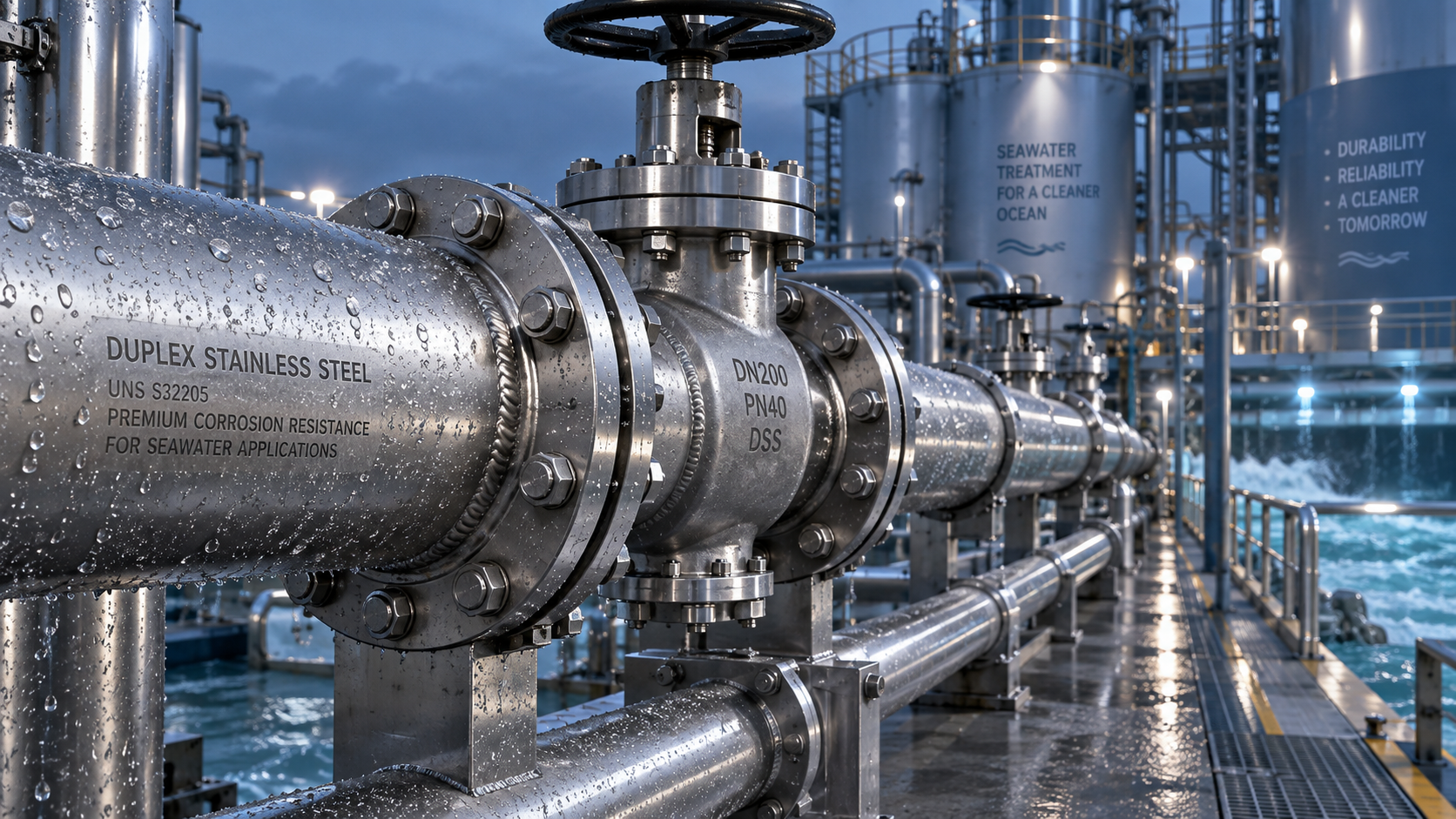
Duplex stainless steel is the right choice for chloride exposure when ordinary austenitic stainless grades are likely to face a combination of persistent wetness, elevated temperature, concentrated salts, tensile stress, or difficult inspection access. Its value is strongest where a corrosion failure would require shutdown, replacement, or intrusive repair rather than a simple surface cleanup.
Chlorides are present in seawater, salt spray, brackish water, cooling-water systems, chemical streams, washdown areas, de-icing environments, and deposits left after evaporation. The chloride concentration in the bulk fluid matters, but it rarely tells the whole story. A component that sees modest chloride levels may still corrode if liquid becomes trapped under deposits, evaporates in a crevice, or remains stagnant at a gasket edge. Material selection should therefore begin with the local conditions at the metal surface, not only the nominal composition of the process medium.
Where the material advantage becomes meaningful
The duplex structure combines ferritic and austenitic phases. This metallurgy gives higher yield strength than common austenitic stainless steels and improves resistance to chloride stress corrosion cracking. It also supports stronger resistance to pitting and crevice corrosion when the grade contains an appropriate balance of chromium, molybdenum, nitrogen, and nickel.
That combination becomes valuable in exposed pipework, pressure-containing equipment, seawater handling systems, offshore structures, heat-transfer equipment, tank internals, pump components, and chloride-bearing chemical service. The case is especially strong when thickness reduction, lower support loads, or fewer corrosion-related interventions can offset a higher initial material cost.
High strength alone is not a reason to specify a duplex grade. A dry structural member in a mildly corrosive atmosphere may gain little from its chloride resistance. Conversely, a thin-walled pipe operating with warm, oxygenated chloride water can be a poor candidate for a lower-alloy austenitic grade even when its mechanical load is modest. The selection decision rests on the interaction of corrosion exposure, temperature, geometry, fabrication, and required service life.
Separate bulk chloride concentration from local concentration
Many premature selections begin with a single chloride value and end with an incomplete conclusion. Bulk concentration is useful, but chloride attack is commonly driven by localized concentration at the surface. Salt water that dries intermittently leaves deposits. Under those deposits, subsequent wetting can create concentrated electrolyte. A crevice beneath a clamp, insulation support, lap joint, gasket, or poorly drained flange may behave far more aggressively than the surrounding fluid.
Crevice corrosion deserves particular attention because a grade that performs well in freely flowing seawater does not automatically perform equally well in stagnant shielded locations. Once oxygen within a crevice is depleted, the local electrochemical conditions change. Acidity and chloride concentration can rise inside the restricted gap, undermining the passive film. The problem is often first detected around fasteners, gasket faces, support details, and external attachments rather than on the open surface of the main component.
Design details can therefore alter the material conclusion. A well-drained, smooth-walled system with regular flushing presents a different demand from one with dead legs, deposits, porous insulation, and intermittent exposure. If the design cannot eliminate these features, the grade assessment should be based on the most severe credible local condition.
Temperature changes the selection faster than many specifications assume
Rising temperature generally narrows the corrosion margin in chloride-bearing service. This is especially relevant to heat exchangers, warm seawater circuits, regeneration loops, hot washdown areas, and equipment that is heated during operation but cools during shutdown. A grade that is acceptable at ambient temperature may become vulnerable when metal temperature increases, particularly where flow is low or deposits accumulate.
Metal temperature should be used rather than only fluid temperature. Tube walls near a heating source, vessel surfaces behind insulation, and areas exposed to solar heating can be hotter than the nominal process stream. Thermal cycling also matters because salts can concentrate during dry or warm periods and become active again when moisture returns.
For this reason, the question is not simply whether chlorides are present. It is whether chlorides are present at a surface that is warm, wet, oxygenated, stressed, and difficult to rinse. The more of these conditions that occur together, the more compelling duplex stainless steel becomes.
Stress corrosion cracking can decide the grade even when pitting appears manageable
Austenitic stainless steels can be susceptible to chloride stress corrosion cracking under a combination of tensile stress, chloride exposure, and temperature. Cracks may initiate from pits, weld toes, cold-worked areas, surface damage, or locations with residual forming stress. They can develop with little general metal loss, which makes visual assessment alone unreliable.
Duplex grades offer substantially better resistance to this mechanism because of their two-phase microstructure. That does not make them immune to cracking. Severe chloride concentration, unsuitable temperature, high residual stress, fabrication defects, or an inappropriate grade can still create a failure path. The distinction is that duplex material often provides a more useful margin where tensile stress cannot be eliminated and chloride exposure is sustained.
This point matters for formed pipe, bend regions, welded assemblies, bolted connections, and pressure-retaining equipment. A corrosion review that considers only pitting resistance can miss the more consequential risk: a crack that propagates through a stressed section before broad surface corrosion becomes obvious.
Choose the alloy family by exposure severity, not by the word “duplex”
Duplex stainless steel covers several alloy levels. Lean duplex grades are often considered where higher strength and improved chloride performance are needed over common austenitic grades, but the chloride environment is not exceptionally severe. Standard duplex grades offer a broader balance for many marine, industrial water, and process applications. Super duplex grades are reserved for more demanding combinations of warm seawater, high chloride content, crevices, aggressive deposits, or a narrow tolerance for corrosion damage.
A grade name by itself is insufficient for comparison. Composition limits, product form, surface condition, weld condition, and required corrosion test methods can all affect suitability. Pitting resistance equivalent values are often used as a first screening tool because chromium, molybdenum, and nitrogen contribute to localized corrosion resistance. They are useful for ranking related alloys, yet they are not a direct service-life prediction. They do not account fully for crevice geometry, biofouling, deposit chemistry, temperature excursions, weld surface condition, or stagnant operation.
Welding and fabrication can preserve or erode the expected performance
The corrosion performance of a duplex component depends on more than the mill certificate. Welding must maintain an appropriate phase balance and corrosion-resistant heat-affected zone. Excessive heat input, insufficient heat input, unsuitable filler selection, poor shielding, or uncontrolled interpass temperature can impair corrosion resistance or toughness. Weld qualification should address the actual product form, thickness range, joint design, and intended service rather than relying on a generic procedure developed for a different application.
Surface condition after fabrication is equally important in chloride service. Heat tint, embedded carbon-steel contamination, grinding debris, weld spatter, and rough crevice-prone details can become initiation sites. Cleaning methods need to restore a clean passive surface without leaving residue or damaging the component. Mechanical cleaning tools used on carbon steel should not be transferred casually to stainless work because embedded iron can create localized staining and corrosion that is later mistaken for failure of the base alloy.
Cold forming also deserves review. Duplex grades are stronger and often require more force during bending, rolling, and forming. Aggressive forming can leave residual stresses and surface damage if tooling, bend radius, and finishing controls are poorly matched to the material. Where the final item will see chlorides at elevated temperature, the fabrication route should be considered alongside the alloy grade rather than treated as a separate production issue.
Connection details often control the outcome
A well-selected duplex pipe spool can still fail prematurely at a mixed-material connection, a crevice-forming support, or a poorly designed gasketed joint. Material compatibility should cover bolts, washers, clamps, valves, flange faces, and small attachments. A lower-resistance fastener or insert may corrode first and contaminate or damage the surrounding assembly.
Galvanic effects require a complete circuit: dissimilar materials, electrical contact, and an electrolyte. The risk increases when the duplex component is small relative to a more active coupled metal, when salt water remains present, or when geometry concentrates current at a local junction. Electrical isolation may be appropriate in some assemblies, but it should be evaluated with grounding, process continuity, and maintenance requirements in mind.
Drainage is often a more effective safeguard than simply increasing alloy content. Avoid horizontal surfaces that retain salt solution, pockets behind brackets, downward-facing crevices, and dead legs that cannot be flushed. For externally exposed equipment, insulation systems need to prevent water ingress and allow drying. Chloride-induced corrosion under insulation can remain hidden until metal loss or cracking has progressed well beyond the visible boundary of the wet area.
When the investment is difficult to justify
A duplex grade is not automatically the best answer for every chloride-containing environment. It can be excessive for low-temperature, low-deposit exposure where a lower-alloy stainless steel has a demonstrated corrosion margin and replacement consequences are limited. It may also be a poor fit where fabrication capability cannot reliably meet duplex welding and handling requirements. A nominally superior alloy installed with poor weld quality, unsuitable consumables, or contaminated surfaces can deliver less value than a simpler grade fabricated under controlled conditions.
There are also services where chlorides are only one part of the corrosion problem. Strong reducing acids, highly oxidizing media, sulfide-containing fluids, abrasive slurries, or certain chemical contaminants can shift the preferred material family. A duplex selection should therefore be tested against the full chemistry, including cleaning agents, upset conditions, stagnant periods, and chemicals introduced during maintenance.
Build the specification around the actual failure mechanism
A useful material specification describes the service envelope rather than merely naming an alloy. It should identify the chloride source, expected temperature range, flow or stagnation conditions, external exposure, wet-dry cycling, deposits, crevices, and stress-producing features. For welded items, it should define applicable fabrication controls, filler requirements where relevant, cleaning expectations, inspection points, and acceptance criteria tied to the corrosion concern.
It is also sensible to distinguish base material from completed equipment. Plate, pipe, bar, and forged components may each have different surface conditions and manufacturing routes. A compliant chemical analysis does not confirm that welded joints, machined surfaces, gasket interfaces, and field modifications have retained the required corrosion performance.
The right decision is reached when the selected grade has enough resistance for the harshest realistic local chloride condition, the fabrication route can maintain that resistance, and the design avoids creating concentrated salt environments that no reasonable material choice should be expected to tolerate indefinitely.
Get real-time quotes
Interested? Leave your contact details.