
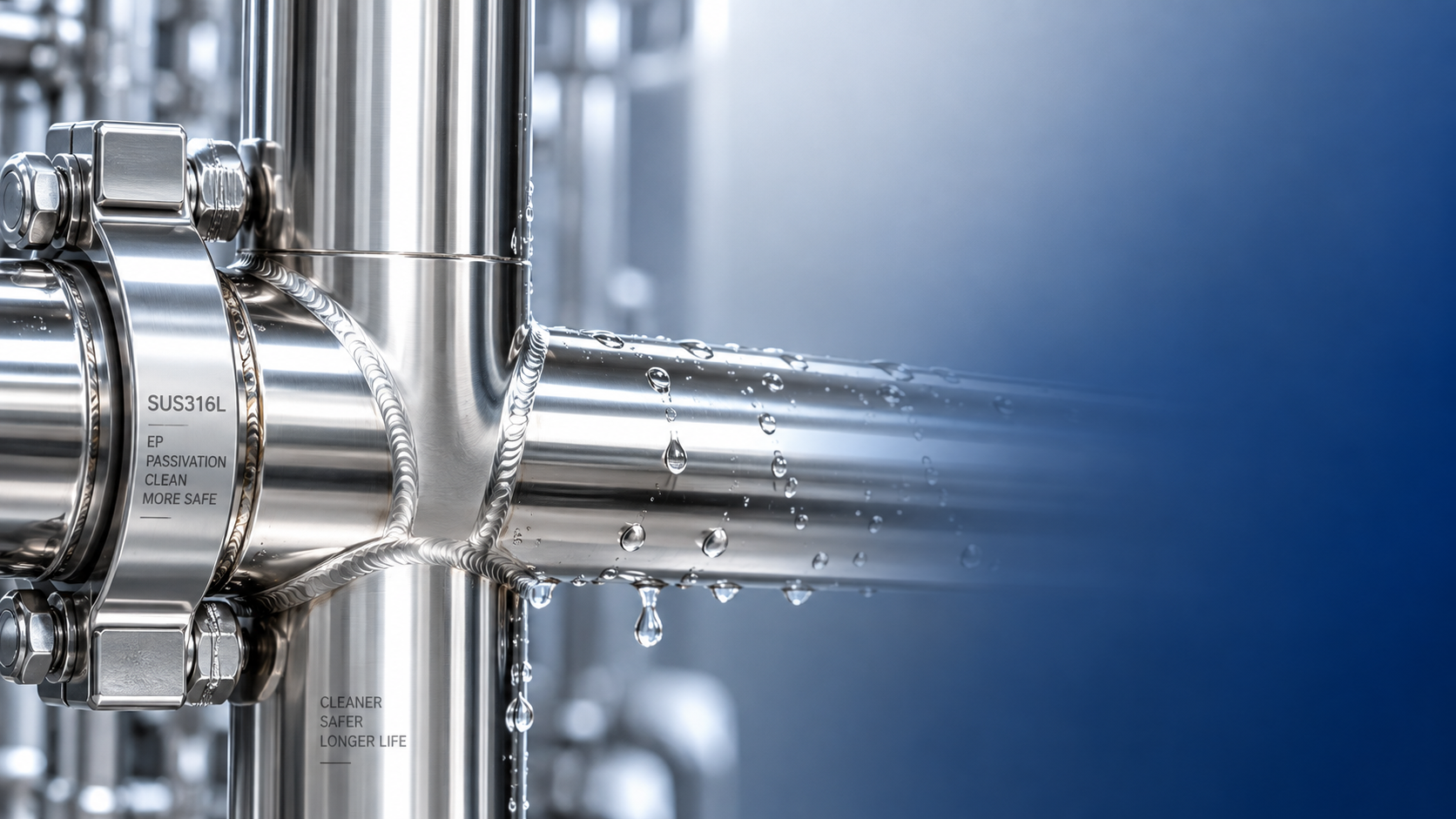
Surface Finish and Corrosion Performance in Stainless Steel Processing
In Stainless Steel Processing, surface finish is a critical factor in determining long-term corrosion resistance, cleanliness, and component reliability. Technical evaluators must consider how roughness, polishing methods, oxide layers, and fabrication contamination influence exposure performance in demanding environments.
The central conclusion is straightforward: a smoother, clean, properly passivated stainless steel surface usually resists corrosion better, but finish selection must match alloy grade, fabrication route, and service environment.
Technical evaluators searching this topic typically need more than a description of polished surfaces. They need a defensible way to judge whether a specified finish will prevent corrosion failures.
The key questions involve corrosion mechanisms, measurable acceptance criteria, post-fabrication treatment, surface contamination, weld zones, cleaning requirements, and the practical trade-offs between appearance, cost, and performance.
Why Surface Finish Changes Corrosion Resistance
Stainless steel resists corrosion because chromium in the alloy forms a thin, adherent, chromium-rich passive film when exposed to oxygen-containing environments.
This passive film is not a permanent protective coating. It can be damaged mechanically, chemically, or electrochemically, then reform if the local surface remains clean and oxygen is available.
Surface finish affects how easily contaminants, moisture, chlorides, process residues, and microorganisms remain attached to the metal. These retained materials can locally disrupt passive-film stability.
Rougher surfaces contain peaks, valleys, scratches, laps, embedded particles, and processing marks. Such features increase actual surface area and create locations where deposits can accumulate.
Once deposits remain wet, the chemistry beneath them can differ significantly from the surrounding environment. Oxygen depletion, chloride concentration, and lower pH can encourage localized corrosion.
This is particularly important because stainless steel often fails through pitting, crevice corrosion, under-deposit corrosion, or weld-related attack rather than through uniform wall loss.
A finish that appears visually acceptable may still perform poorly if it contains deep scratches, smeared metal, abrasive residue, free iron contamination, or poorly cleaned fabrication debris.
For evaluators, surface finish should therefore be treated as an engineering variable. It influences corrosion initiation, cleaning effectiveness, inspection reliability, and the predictability of in-service performance.
Which Surface Conditions Create the Highest Corrosion Risk?
The greatest concern is usually not an ordinary mill finish alone. Risk rises when the surface contains defects or contamination that create localized electrochemical differences.
Deep grinding marks are a common concern because they form narrow channels that retain water and contaminants. Their direction can also complicate cleaning and drainage.
Coarse abrasive finishes may leave sharp surface features, while excessive polishing pressure can smear material across the surface and trap abrasive particles within the metal.
Free iron contamination is especially significant in Stainless Steel Processing. Carbon-steel tools, wire brushes, grinding dust, lifting equipment, and worktables can transfer iron onto stainless surfaces.
Transferred iron can rust quickly in humid service. The visible staining may be mistaken for stainless steel corrosion, but it can also create conditions that promote localized attack.
Heat tint around welds presents another major risk. During welding, chromium near the surface can be depleted while thicker oxide scales develop in and beside the heat-affected zone.
If heat tint is not removed appropriately, the affected area may have lower pitting resistance than adjacent base material. This problem becomes more serious in chloride-bearing service.
Embedded abrasive grains, pickling residues, polishing compounds, oil films, and incomplete rinsing can also undermine performance. A clean appearance is not evidence that these residues are absent.
How Surface Roughness Should Be Evaluated
Surface roughness is often expressed as Ra, the arithmetic average roughness value. It is useful, but it should not be interpreted as a complete corrosion-resistance indicator.
Two surfaces with the same Ra value can behave differently because Ra does not fully describe peak shape, valley depth, scratch direction, waviness, porosity, or contamination.
For corrosion-sensitive applications, evaluators should review both numerical roughness requirements and the process used to create the finish. Process history often explains hidden risk.
A low Ra value obtained through controlled mechanical polishing may be suitable for many applications. However, final cleaning and passivation remain necessary to restore a corrosion-resistant condition.
In sanitary, pharmaceutical, food, semiconductor, and high-purity fluid systems, smoother finishes are often specified to improve cleanability and reduce residue retention.
Common requirements may include Ra limits near 0.8 micrometers or lower, depending on the process fluid, cleaning regime, hygiene standard, and inspection method.
These values should not be copied automatically across applications. Outdoor architectural panels, pressure vessels, marine fittings, and process piping face different contamination and cleaning conditions.
Evaluators should also specify measurement direction, sampling locations, instrument calibration, cut-off settings, and whether roughness measurements include welded or repaired areas.
Mechanical Polishing, Electropolishing, and Their Different Effects
Mechanical polishing improves surface smoothness by progressively removing material with abrasives. It can reduce roughness effectively, but its outcome depends heavily on technique and cleanliness.
Poorly controlled mechanical polishing can leave abrasive embedment, directional scratches, localized overheating, and surface smearing. These defects may reduce the benefit of a lower roughness value.
Electropolishing removes microscopic surface material electrochemically. It preferentially smooths micro-peaks, improves surface uniformity, and can produce a chromium-enriched passive surface condition.
For demanding corrosion environments, electropolishing is often valuable after fabrication because it improves cleanability and removes some damaged surface layers created by grinding or machining.
However, electropolishing is not automatically suitable for every component. Geometry, weld quality, internal access, dimensional tolerance, masking requirements, and chemical handling capacity must be considered.
It cannot reliably correct major fabrication defects, porosity, incomplete weld penetration, deep mechanical damage, or improperly removed heat tint. Preparation quality still determines the final result.
Mechanical polishing may be sufficient for moderate indoor exposure when followed by appropriate cleaning and passivation. Electropolishing becomes more compelling when deposits, chlorides, or stringent hygiene requirements are expected.
A technical specification should identify the desired final condition rather than simply stating “polished.” It should define finish method, roughness target, cleaning sequence, and inspection acceptance requirements.
Why Cleaning and Passivation Matter After Fabrication
Cleaning removes oils, polishing compounds, shop dirt, fingerprints, chlorides, and other residues that can prevent uniform passive-film formation or create localized corrosion sites.
Passivation typically uses nitric acid or citric acid formulations to remove free iron and promote restoration of a chromium-rich passive surface after proper cleaning.
Passivation does not remove thick weld oxide, scale, heavy heat tint, or deeply embedded contamination. These conditions usually require pickling, mechanical removal, or controlled electropolishing first.
A common mistake is specifying passivation as a universal remedy. In reality, it is a finishing step within a broader surface preparation process, not a substitute for defect removal.
Post-treatment rinsing is equally important. Acid residues, dissolved salts, and inadequate water quality can create new corrosion risks, especially inside pipework, tanks, and complex assemblies.
For critical systems, specifications should state acceptable rinse-water quality, drying requirements, chemical concentration ranges, treatment time, temperature, and documentation expectations.
Technical evaluators should request evidence that the processor controls chemical baths and avoids cross-contamination. A passivation certificate without process traceability provides limited assurance.
When stainless steel components are shipped or stored after treatment, protective packaging should also prevent exposure to chlorides, carbon-steel dust, standing water, and abrasive contact.
How Welding Alters the Surface and Corrosion Behavior
Welded areas require separate attention because welding changes surface oxide condition, local microstructure, residual stress, geometry, and the ability to clean the finished component.
Visible heat tint is an important indicator, although its color alone does not provide a complete corrosion assessment. Darker oxide generally signals greater surface oxidation during welding.
For stainless steel exposed to chlorides, heat tint should normally be removed where corrosion resistance is critical. Mechanical brushing alone may not restore the original surface condition.
Pickling can remove weld oxides and chromium-depleted surface layers when applied correctly. It must be followed by thorough rinsing, neutralization where required, and controlled drying.
Weld profiles also affect corrosion performance. Undercut, overlap, spatter, crevices, incomplete penetration, and unblended weld toes can retain corrosive solutions and complicate cleaning.
Internal weld quality is especially important in piping and vessels. Rough root beads, discoloration, and trapped residues may remain hidden until leakage, contamination, or corrosion occurs.
Purging with suitable shielding gas helps limit oxidation on root surfaces. Nevertheless, purge quality should be evaluated alongside weld procedure controls, inspection records, and final surface treatment.
Specifications should distinguish between cosmetic weld appearance and functional corrosion performance. A visually smooth weld is beneficial, but it does not prove that oxide removal and passivation were completed.
Matching Finish Requirements to the Service Environment
Finish selection should begin with the actual environment, not with a default surface designation. Exposure chemistry and maintenance conditions determine which surface characteristics matter most.
Indoor dry applications may tolerate standard mill or brushed finishes if fabrication contamination is controlled. The principal concerns are usually appearance, handling marks, and occasional cleaning.
Outdoor applications require attention to rain washing, airborne salts, industrial pollutants, sheltered geometry, orientation, and cleaning access. A smoother finish can reduce staining and deposit retention.
Coastal and marine service creates a higher chloride burden. In these environments, alloy grade, surface finish, weld treatment, drainage, and maintenance should be evaluated as one system.
Food and beverage equipment requires surfaces that can be cleaned consistently without retaining product residues. Smoothness, weld blending, hygienic geometry, and chemical compatibility are equally relevant.
Pharmaceutical and biotechnology systems often demand tighter finish controls because cleaning validation, microbial control, extractables, and product purity can be affected by surface condition.
Chemical processing equipment requires a more detailed review of specific media, concentration, temperature, oxygen availability, contaminants, flow velocity, and upset conditions.
A highly polished finish cannot compensate for selecting an unsuitable stainless grade. Conversely, a capable alloy can still fail prematurely when fabrication leaves deposits, crevices, or weld oxides.
What Technical Evaluators Should Include in Specifications
A useful specification defines functional outcomes and verification methods. Vague requirements such as “corrosion resistant finish” or “high polish” leave too much room for inconsistent interpretation.
Start by identifying the stainless steel grade, product form, intended environment, expected service life, cleaning chemicals, operating temperature, and credible contamination sources.
Then define the required finish using a recognized designation where appropriate, supplemented by measurable roughness limits, visual standards, and restrictions on scratches or surface defects.
For fabricated assemblies, identify whether weld heat tint must be removed, which treatment method is acceptable, and whether interior surfaces receive the same finishing controls.
State cleaning and passivation requirements clearly. Include allowable process chemicals, rinse quality, post-treatment handling, packaging controls, and documentation needed for critical applications.
Inspection criteria should include visual examination under defined lighting, roughness measurement where relevant, verification of treatment records, and targeted tests for contamination or passivation quality.
Depending on risk, evaluators may consider ferroxyl testing for free iron, water-break testing for cleanliness, copper sulfate testing, or corrosion testing under representative conditions.
Acceptance plans should also define repair procedures. Rework by uncontrolled grinding can damage a compliant surface, so repaired areas must receive equivalent finishing and verification.
Common Evaluation Errors That Lead to Avoidable Failures
One frequent error is treating surface roughness as the only quality metric. Ra is useful, but corrosion performance also depends on cleanliness, defects, oxide condition, and geometry.
Another error is relying on visual appearance alone. Brightness and reflectivity do not confirm the absence of free iron, embedded particles, chloride residues, or chromium-depleted weld zones.
Evaluators also sometimes specify mirror polishing where it provides little operational benefit. This can increase cost while overlooking more important controls such as drainage and weld treatment.
Conversely, cost-focused specifications may accept coarse finishing without considering the expense of later cleaning difficulties, contamination events, staining complaints, or premature localized corrosion.
Using carbon-steel tools in stainless fabrication areas is another preventable problem. Tool segregation, dedicated handling equipment, and clean workspaces provide meaningful risk reduction.
Failure investigations often reveal that the stainless grade was blamed too quickly. Surface contamination, heat tint, stagnant deposits, poor cleaning access, or chloride exposure may be the actual cause.
A disciplined Stainless Steel Processing review considers material selection, finish, fabrication method, post-treatment, installation details, operation, and maintenance as connected performance factors.
Making a Practical Finish Selection Decision
Technical evaluators should first classify the corrosion consequence. Components affecting safety, containment, product purity, uptime, or regulatory compliance require more conservative finish controls.
Next, identify the dominant corrosion drivers: chlorides, stagnant moisture, deposits, cleaning chemicals, elevated temperature, biological residues, outdoor pollution, or internal process media.
Then assess whether the chosen finish can be consistently achieved across flat surfaces, edges, welds, internal passages, repairs, and difficult-to-access component features.
The best decision is rarely the smoothest available finish. It is the finish that provides sufficient corrosion resistance, cleanability, manufacturability, and inspection confidence at justifiable total cost.
Where service conditions are uncertain, representative corrosion testing, trial fabrication, and documented cleaning studies can be more valuable than relying solely on generic finish descriptions.
Supplier capability should be reviewed early. Ask whether the processor can control abrasive media, segregate carbon steel, remove heat tint, passivate effectively, and document each operation.
Conclusion
Surface finish has a direct and practical effect on stainless steel corrosion resistance because it controls deposit retention, contamination risk, passive-film quality, cleanability, and local electrochemical conditions.
For technical evaluators, the most reliable approach is to assess finish together with alloy grade, welding, cleaning, passivation, geometry, operating environment, and verification requirements.
In Stainless Steel Processing, a lower roughness value can be beneficial, but it should never be accepted as proof of corrosion performance without reviewing the complete finishing process.
Well-written specifications focus on measurable surface condition, fabrication cleanliness, weld treatment, post-processing controls, and service-specific acceptance criteria. This approach reduces failures and improves long-term component reliability.